WOODEN HOUSE & FIRE
ABSTRACT
Believe it or not but a wooden house is not more inflammable than a stone house. This, of course, applies to houses that are properly designed and constructed. Fire safety requirements are different in different countries but the reason is rather connected with traditions and prejudice. Fortunately, there is a spread of a function-based approach where there are no specific numerical limits, e.g. on the number of floors, sidings, etc, but which requires calculatory proof of the fact that the residents’ safety in case of fire stays within the required limits.
The main source of inflammability in a dwelling house is its resident. This is why in the USA, for instance, it is obligatory to use sprinklers nearly everywhere, but strangely less attention is paid to the lanes between the houses or the windows in the walls of the houses confronting each other.
It is not possible to turn timber into non-inflammable material using any impregnation or chemical protection, it can only be made poorly inflammable. The behavior of timber in case of fire is predictable. For instance, the surface of a main support beam profoundly carbonizes ca 0.8 mm/min, therefore it is easy to find the cross-section of such beam in good order to guarantee that the carrying remains, for instance, after 60 minutes of burning. The part unburnt retains all of its carrying capacity.
Steel, for instance, heats up fast in the fire, and the construction may collapse at the yield point (not to mention melting). In this sense, timber is more resistant to fire than steel. As it is said before, the strength characteristics of the timber untouched by fire (in the middle of the cross-section) do not change, and the construction stands as long as the whole part of the cross-section can carry the load. That is why you see a collapsed spaghetti-like structure when a steel structure has burnt down and may see a timber structure still standing but fully charcoaled. Which one is safer?

ADDITIONAL INFORMATION
FOR THOSE WHO WANT TO KNOW MORE ABOUT HOW TIMBER BURNS
Timber catches fire either directly from a flame or in great heat. In the absence of flames, the surface temperature needs to rise above 400ºC to ignite. In the presence of flames, timber ignites when the surface temperature has been at 300ºC for some time. This is a faster process with soft wood than compared to hardwood. Fire spreads along the surface of a wooden element, giving rise to new places of fire. In the beginning, the burning is intensive, as a result of which an isolating charcoal layer is formed around the cross-section. Chemical decay begins in the interaction of charcoal and combustible gases, and a so-called pyrolytic layer is formed between undamaged and charred timber. This is a five-millimeter-thick zone where timber has been chemically influenced by fire but has not been completely decayed. When during the fire the timber under the pyrolytic layer has reached the temperature of 100ºC, the water in the timber begins to vaporize. The temperature stops rising as long as all of the water has vaporized. Very little gas is produced at above 500ºC. However, char “production” is increasing. This explains the look of the timber after the fire. The thermal conductivity of charcoal is only 1/6 of the thermal conductivity of timber. This means that the charcoal layer forms an insulation around the undamaged timber that slows down its further damage. Thanks to the insulating charcoal layer the temperature of timber is considerably lower deep inside than in the surface layer. The core of the cross-section of the wooden element remains cold even at a short distance from the burning zone. This avoids damaging temperature strains in the construction as a whole. Unburnt parts retain all of their physical properties of carrying capacity, except for diminishing in size. The time spent on ignition and burning depends on the density of the timber. The greater density of timber, the poorer inflammability and that is the big advantage of using our tropical hardwood with a density 5 times greater than softwood.
WOODEN HOUSE ABLAZE
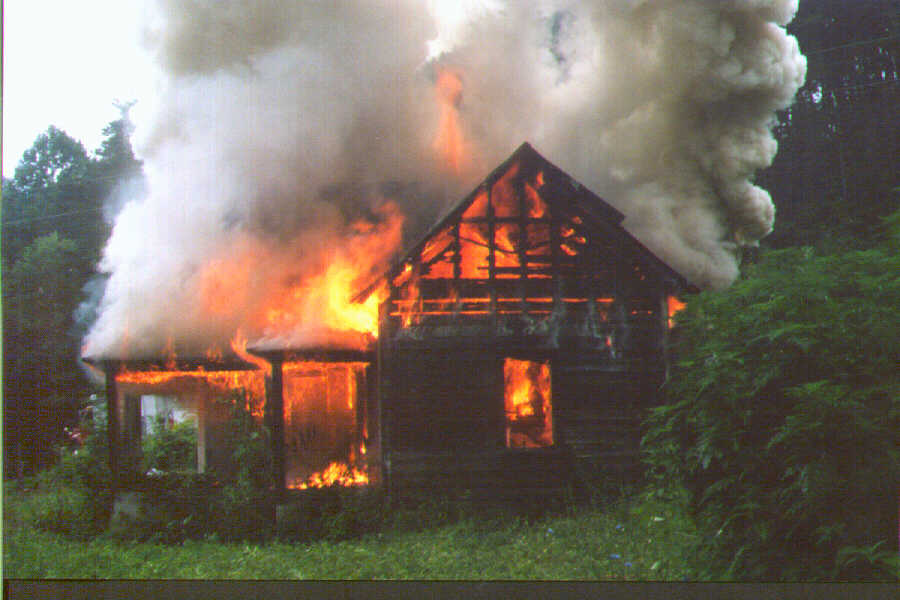
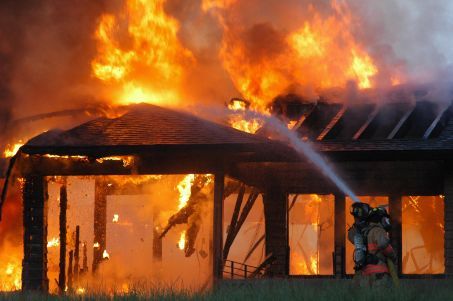
A wooden house on fire. Despite the enormously high temperature the house did not collapse. The trusses, main beams, and columns remained intact. Unburnt parts retained all of their physical properties of carrying capacity, except for diminishing in size.
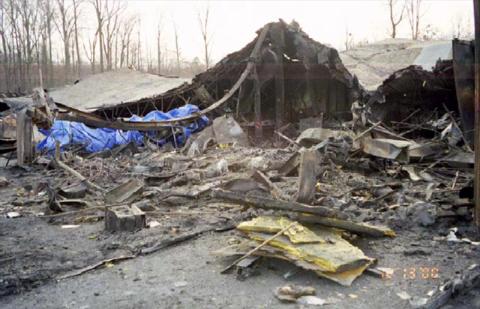
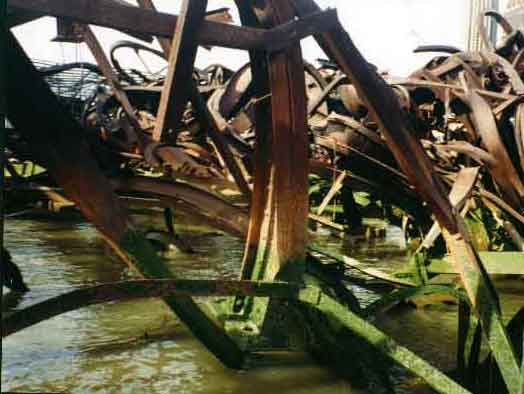
A steel structure after a fire. The steel elements have been heated beyond their yield point and melted down to a spaghetti-like mass.
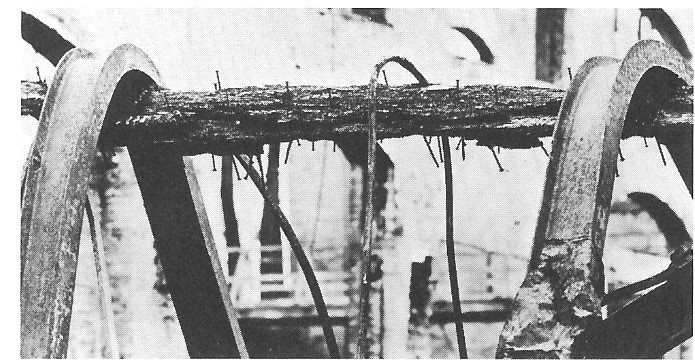
The great San Fransisco fire after the earthquake in 1906 destroyed a large part of the city, in particular, steel buildings became victims of the heat. The picture shows a wooden beam supporting 2 collapsed steel beams after the fire. Proof and evidence that solid wood lasts longer and remains stronger during a fire.